The Copernicus Emergency Management Service: an invitation to use EU space-based tools for disaster and crisis management
Peter Salamon – European Commission’s Joint Research Centre, Copernicus Emergency Management Service
When floods inundate a city, wildfires spread, or drought threatens water supplies, authorities need fast, accurate information. They rely on scientists and practitioners to find, generate, and interpret near real-time, trustworthy data.
Preparing these data, often as ready-to-use maps, dashboards, or datasets, is central to the Copernicus Emergency Management Service (CEMS). Throughout this article we illustrate how satellite-derived geospatial information has helped Spain prepare for, respond to, and recover from disasters.
Alerts that anticipate floods and maps showing their extent
Anticipation is the first line of defence. The European Flood Awareness System (EFAS) provides forecasts and alerts for ongoing and upcoming floods in Europe, warning registered users up to ten days in advance. This complementary information provides authorities a broader information basis allowing them to act such as pre-position resources, warn the public, and prepare evacuations before water levels peak.
To respect national warning responsibilities and the “single-one-voice” principle, EFAS notifications have a 30-day embargo before public release. During this period, access is limited to EFAS partners. National, regional, or local authorities with flood risk responsibilities can be granted access.
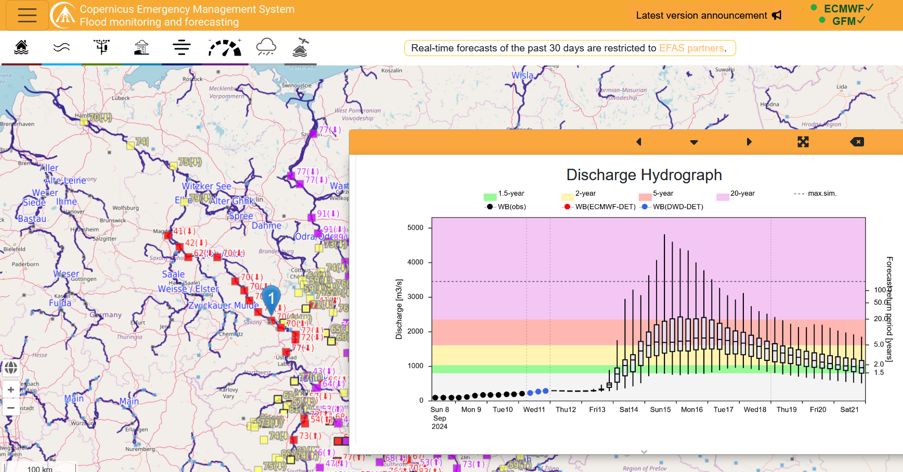
Figure 1. Flood forecast for Central Europe in September 2024, with discharge hydrograph indicating elevated 5- to 20-year return period risk © EU 2024. Licensed under CC BY 4.0.
Source: EU Flood Awareness System.
At global scale, the Global Flood Awareness System (GloFAS) extends this early warning approach beyond Europe. Unlike EFAS, its data is openly accessible upon registration, making it useful for Spanish development agencies and humanitarian organisations operating internationally.
Within GloFAS, the Global Flood Monitoring (GFM) tool uses Copernicus Sentinel-1 radar data to map surface water extent and flood dynamics worldwide in near real time.
Monitoring and mapping wildfires
Beyond floods, the EU Forest Fire Information System (EFFIS) provides near real-time and historical data on forest fires across Europe, the Middle East, and North Africa.
Its statistics portal offers data on burnt areas, fire numbers, and CO₂ emissions over custom periods. For example, 2025 was the EU’s worst fire season since EFFIS records began.
According to the same records, which cover only fires larger than 30 hectares that burned at least partially in forested areas, Spain also experienced its largest burnt areas (393 079 hectares) since 2006.
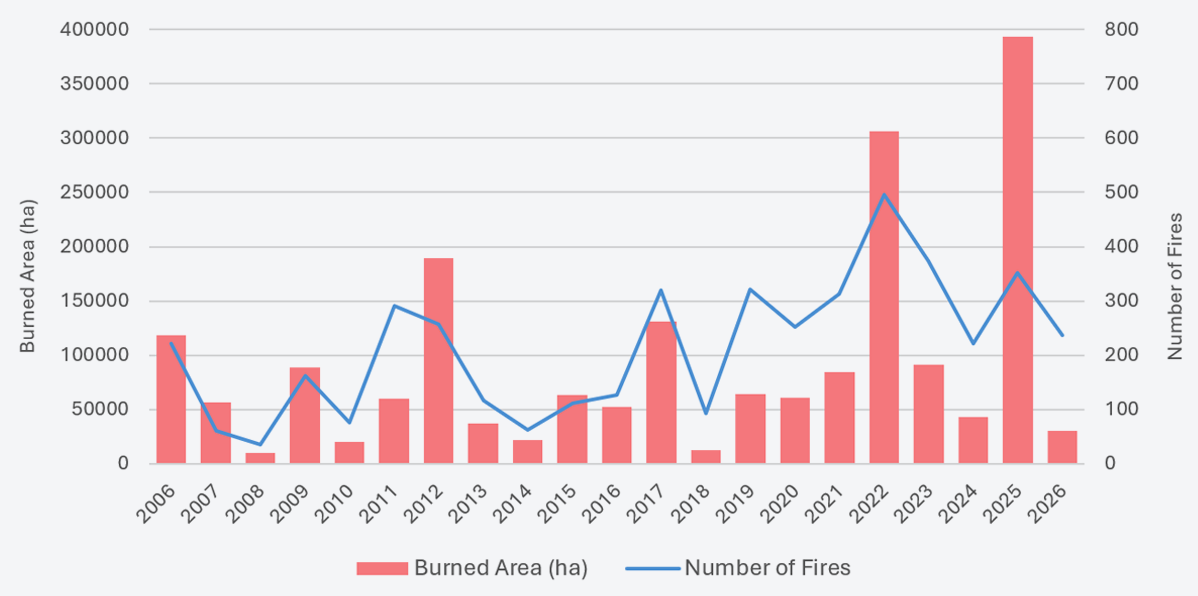
Figure 2. Annual wildfire statistics for Spain. Statistics up to 2025 show full-year data; 2026 data go until May. Includes fires above 30 hectares. © EU 2026. Licensed under CC BY 4.0.
Source: EU Forest Fires Information System.
EFFIS also provides a current situation viewer (wildfire danger, active fires, burnt areas), long-term weather forecasts, and a wildfire risk viewer. The Global Wildfire Information System (GWIS) extends this capacity globally.
Observatories assessing drought conditions
CEMS also includes the European and Global Drought Observatories. Although drought develops more slowly than floods or fires, its impacts on agriculture, water supply, energy, and ecosystems can be severe.
These observatories provide early warning and monitoring maps based on satellite data, hydro-meteorological models, and in-situ observations. The Combined Drought Indicator (CDI) integrates precipitation anomalies, soil moisture deficits, and vegetation stress into maps updated every ten days.
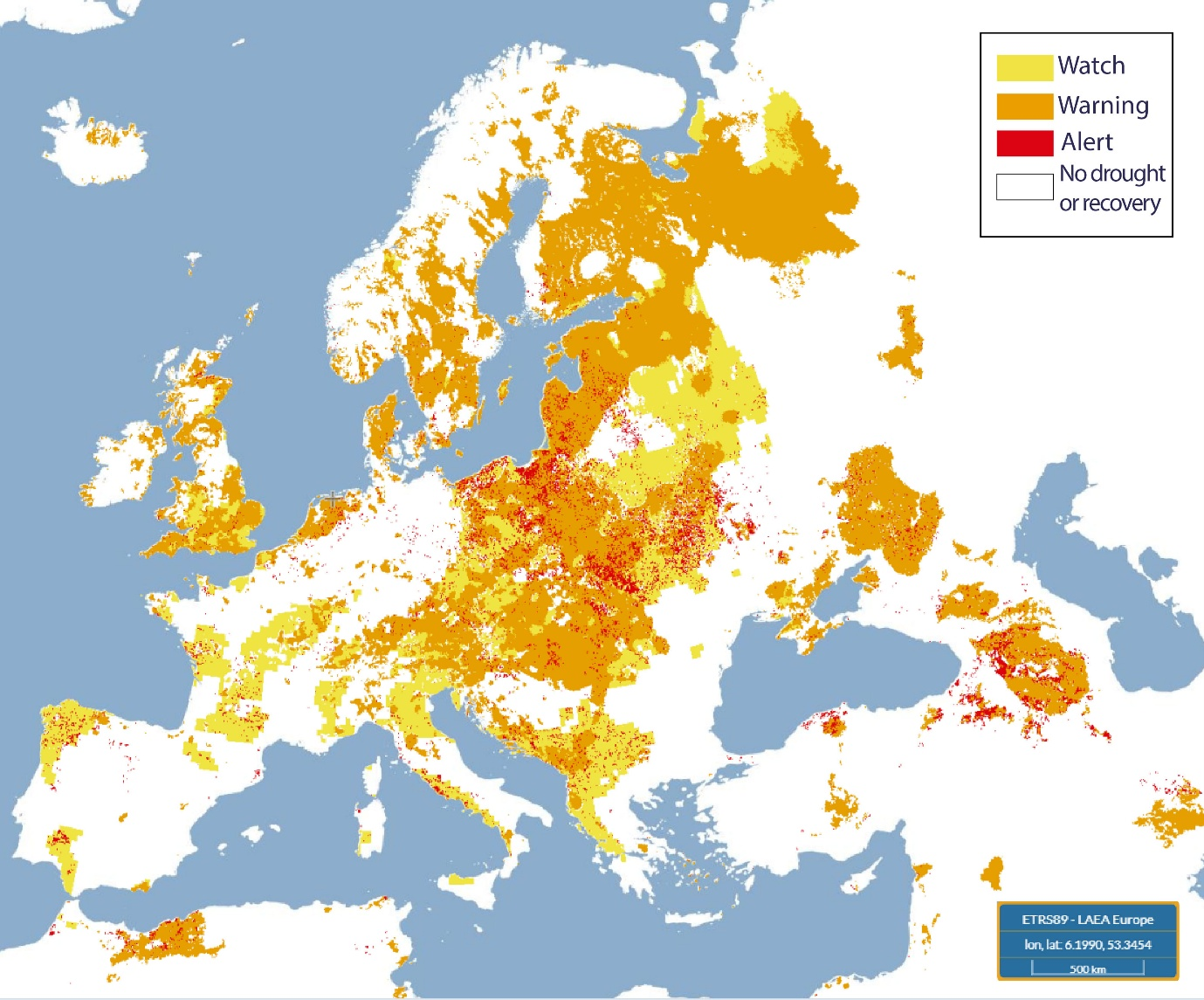
Figure 3. Drought conditions in Europe in mid-May 2026. © EU 2026. Licensed under CC BY 4.0.
Source: EU Drought Observatory.
One of the newest products of the drought observatory forecasts unusual warm and cool conditions (heatwaves and cold spells), as shown in the image below.
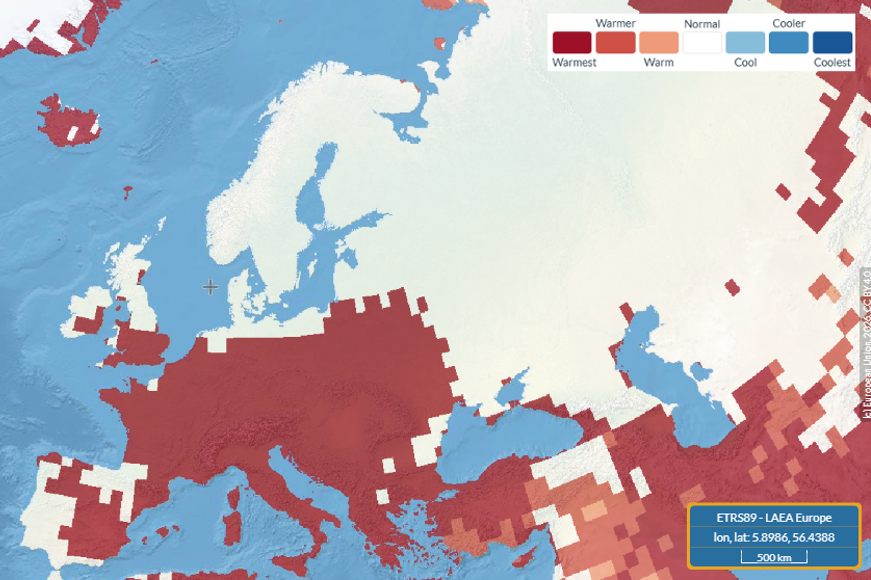
Figure 4. Forecast of unusual warm and cool conditions from June 2026 to August 2026 showing maximum level of alert for warmer temperatures across Europe. © EU 2026. Licensed under CC BY 4.0.
Source: EU Drought Observatory.
From monitoring and alerts to real-time emergency support
When disasters such as floods, wildfires, storms, earthquakes, or landslides occur, early warning shifts to active response. Copernicus On-Demand Mapping delivers time-critical geospatial products during and after events.
La Palma Volcanic Eruption
Since 11 September 2021 the island of La Palma had been experiencing intense seismic activity and after more than 6,000 recorded earthquakes, the Cumbre Vieja volcano erupted on 19 September, lasting 85 days. Over 7,000 people were evacuated, and the lava flow covered an area roughly 6.2 km long, affecting over 1,200 hectares.
Copernicus was activated within hours of the eruption starting, following the request of the Spanish Civil Protection on behalf of the Autonomous Region of Canarias. What followed was a huge operational effort: 64 damage grading maps and 126 products in total delivered over 90 days.
Grading maps classify structures and infrastructure by damage severity using very high-resolution optical and radar satellite imagery, allowing authorities to track in near-real time how many more buildings and hectares had been affected since the previous acquisition.
Copernicus had been running even before the eruption, monitoring ground deformation from the preceding seismic activity to help anticipate where and when a vent might open.
The work continued well after the lava stopped. Post-eruption activations covered ongoing ground deformation monitoring, soil erosion and landslide risk assessment, and updated satellite-derived terrain models helped understand how permanent the lava had reshaped the island’s surface. In recognition of this effort, in March 2022 the Copernicus Emergency Management Service was awarded the Civil Protection Medal of Merit by the Spanish Ministry of the Interior (Ministerio del Interior), given by King Felipe VI.
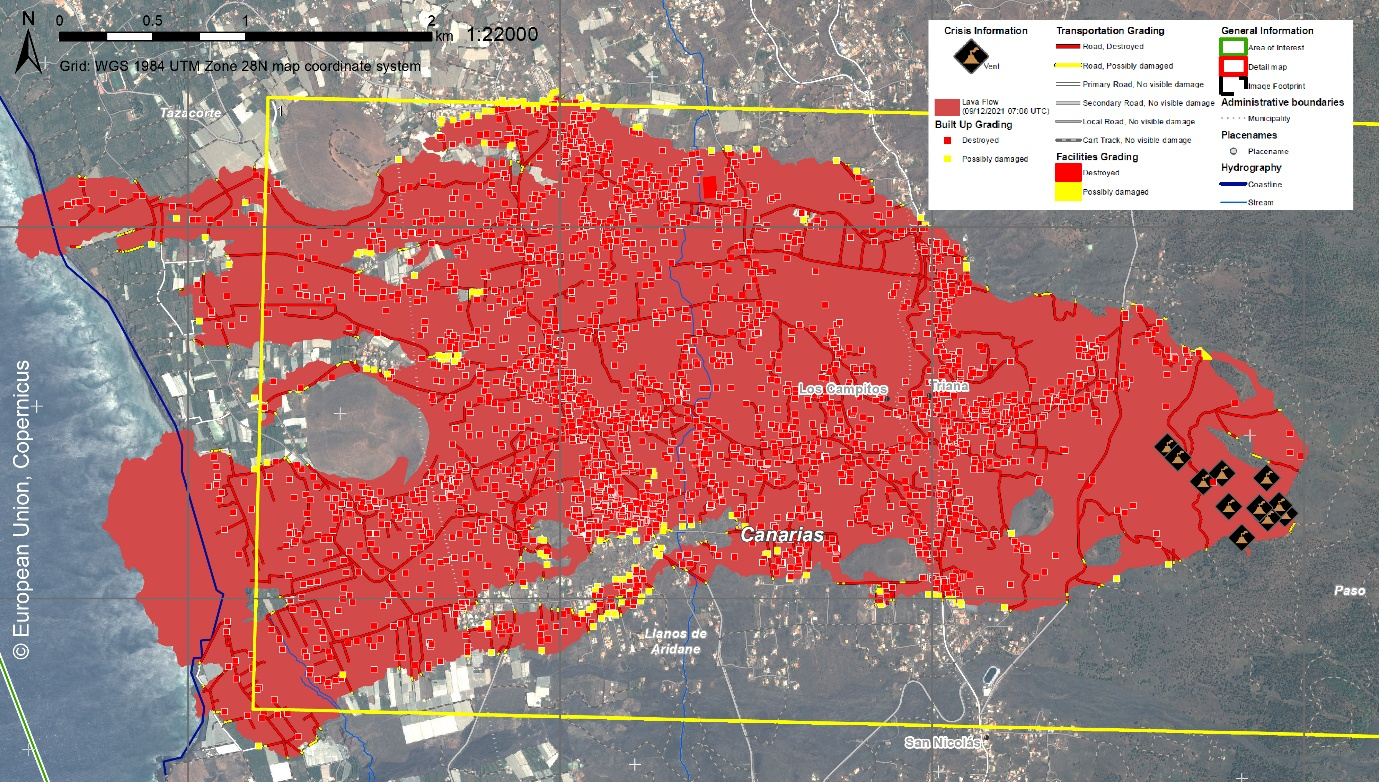
Figure 5. Grading map in La Palma (Spain) showing built-up areas destroyed or possibly damaged by lava flows. © EU 2021. Licensed under CC BY 4.0.
Source: Copernicus Emergency Management Service.
Emergency maps for wildfires in Ourense, Galicia, Zamora, and Castile and León
In mid-August 2025, wildfires across western Spain burned over 50,000 hectares, killing three people and forcing around 9,000 residents to evacuate. Activated within hours by Spain’s Ministry of the Interior, Copernicus delivered the first satellite-derived maps just nine hours after the request. 145 maps across 17 areas of interest to support civil protection authorities and the EU Response and Coordination Centre (ERCC).
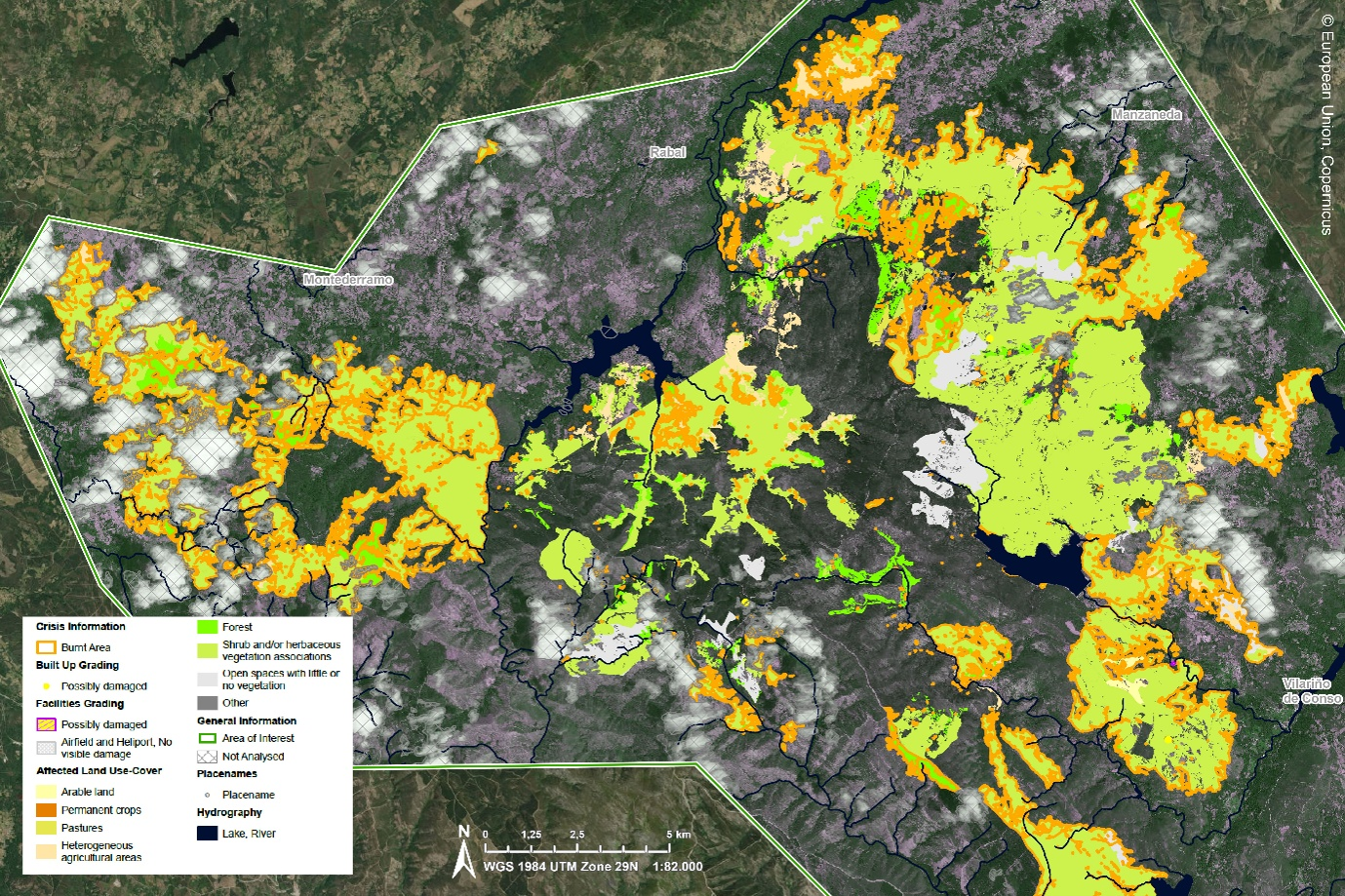
Figure 6. Grading map in A Gudiña (Spain) in August 2025 showing the extent of the wildfire and the types of vegetation affected. Licensed under CC BY 4.0.
Source: Copernicus Emergency Management Service.
CEMS also integrates population and settlement data through the Global Human Settlement Layer (GHSL), improving risk and impact analysis by linking hazards to exposure. In the fire mentioned above, this layer estimated 6 constructions for mining or extraction possibly damaged. It also pointed to 7,200 inhabitants affected in the entire area of interest, as well as 350 residential buildings and 4 wholesale and retail trade buildings, among other types of settlements.
Rapid maps for the floods in Valencia
On 29 October 2024 a cut-off low (in Spanish DANA for Depresión Aislada en Niveles Altos) event inundated 78 municipalities across Valencia, Castilla-La Mancha and Andalusia, making 230 victims. Spain’s Ministry of the Interior, through the Centro Nacional de Emergencias (CENEM) de la Dirección General de Protección Civil y Emergencias requested Copernicus’ rapid maps in that same afternoon.
Working across 36 areas of interest and drawing on multiple satellite sources, the service tracked the evolving flood extent over the following weeks, ultimately delivering 108 maps to support damage assessment, search and rescue coordination, and the broader emergency response coordinated through the EU Civil Protection Mechanism.
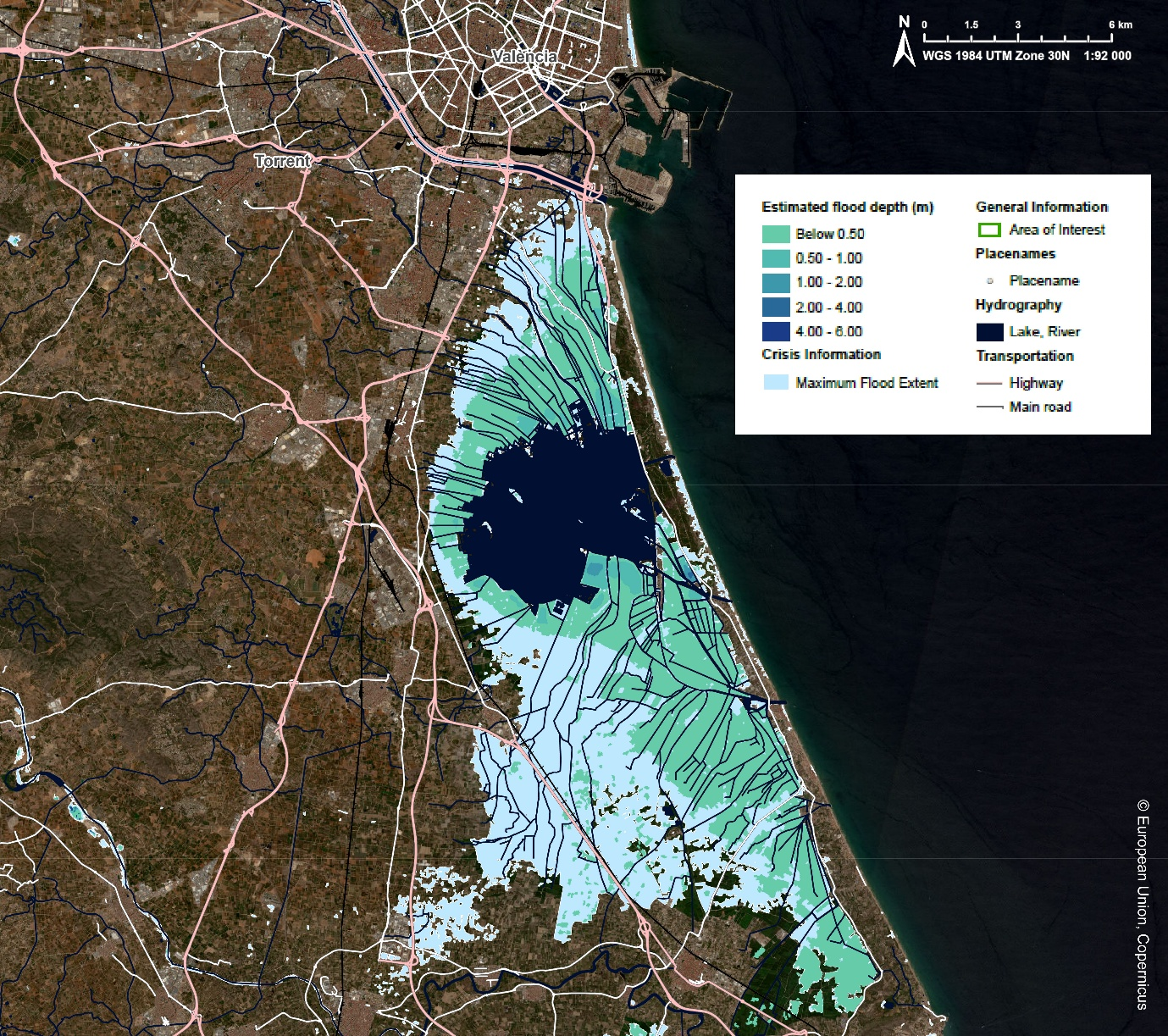
Figure 7. Delineation map in Valencia (Spain) in November 2024 showing areas with different flood depths. Licensed under CC BY 4.0.
Source: Copernicus Emergency Management Service.
Access and use
Following the free and open data policy of the Copernicus program all CEMS products are freely accessible except for EFAS real-time forecasts, which are restricted to authorised users, usually river basin management bodies and civil protection authorities. The CEMS On-Demand Mapping can also only be activated by authorised users, typically civil protection agencies.
In Spain, activation requests are coordinated through the National Centre for Emergencies (CENEM), which validates requests and submits them to the European Emergency Response Coordination Centre (ERCC). Authorities and civil protection organisations should contact CENEM as a first step.
The Copernicus Emergency Management Service for disaster management
The Copernicus Emergency Management Service (CEMS) represents a timely, reliable, and actionable resource for disaster management that anyone, including Spanish authorities at all levels, can draw on before, during, and after disasters.
CEMS products range from on-demand maps for emergency response or risk assessment to exposure mapping and to monitoring and forecasting of floods, droughts, and forest fires. The examples from Valencia’s flood, La Palma’s volcanic eruption, and the wildfires of western Spain demonstrate that satellite-derived data can support better-coordinated responses, helping to mitigate risks and protect lives and livelihoods.
Following the free and open data policy of the Copernicus program all CEMS products are freely accessible except for EFAS real-time forecasts, which are restricted to authorised users, usually river basin management bodies and civil protection authorities. The CEMS On-Demand Mapping can also only be activated by authorised users, typically civil protection agencies.