Takeaways for the Insurance Sector from the Valencia Floods
President of UNESPA [Spain’s Insurers Association]
Something changed in the Valencia Region on 29 October 2024. This is a region that is used to the flooding caused by torrential rains that come in autumn but do not usually disrupt daily life. But that day was entirely different. A DANA, from the Spanish abbreviation for a closed upper level low or a cut-off low storm system, dropped more than 770 litres per square metre in just 24 hours. To put this in perspective, this is the volume of precipitation that falls on the province of Valencia in 19 months.
What happened in Valencia a year ago has seen its like only a very few times in Spain. Personal injury and property damage from other recent natural phenomena like the Lorca (Murcia) earthquake in 2011, the volcanic eruption on La Palma in 2021, or the flash flood that washed away a campsite in Biescas (Huesca) in 1996 were much lower. Not even the Bilbao Floods in the summer of 1983, the largest recent natural disaster up to that time, was comparable. What took place in Valencia was on a completely different scale. Right from the start, we in the insurance industry knew that we were up against the worst natural catastrophe in recent history in our country.
The three pillars of the insurance system
Spain’s insurance model uses a system of public-private partnership that provides a solid basis for tackling climate risk. This model rests on three quite well-defined pillars: insurers, Agroseguro, and Consorcio de Compensación de Seguros (CCS).
Private insurers cover personal injuries and property damage suffered by insured parties due to rain, winds under 120 km/h, hail, snow, and wildfires both from natural causes and by arson.
Farm and agricultural risks are a second pillar. This is where Agroseguro comes in. It is a pool of 16 insurers who have joined together to offer coverage for crops and livestock against a wide range of weather events, from draughts to floods. This pillar involves various types of public-private partnership. First, CCS acts as a reinsurer and co-insurer for Multi-Peril Agricultural Insurance in Spain, and second, through subsidies government authorities encourage producers to take out insurance coverage for a series of crops. Government assistance can sometimes cover as much as 50% of the cost of insurance.
At the same time, CCS is the public entity tasked with paying compensations for personal injuries and property damage caused by floods, winds faster than 120 km/h, coastal flooding, earthquakes, and volcanic eruptions. All these extreme natural phenomena are classified under the umbrella term of “extraordinary risks”.
CCS is funded by a surcharge on all personal injury and property damage policies and life and accident insurance policies issued in Spain, entitling all insured parties, from homeowners to big companies, to compensation for losses after any of the events set out above. Anyone that has taken out private insurance coverage also enjoys coverage against extraordinary risks. Entitlement to compensation is not dependent on a decision by any government authority.
The system is based on an overarching principle of solidarity, namely, mutualisation of risk. Everyone who takes out insurance in Spain pays in a little so that when the time comes, no-one is left to face tragedy alone. Thanks to this, CCS has sufficient resources to deal with huge catastrophes like the one in Valencia.
Another salient feature of the system is that all risks are treated exactly the same. That is, the surcharge paid by someone who lives in an area prone to flooding, like southeast Spain, is the same as the surcharge paid by someone who lives in an area that is not. The amount of the surcharge varies with the total sum insured under each policy, not with risk location.
A protocol designed to achieve a coordinated response
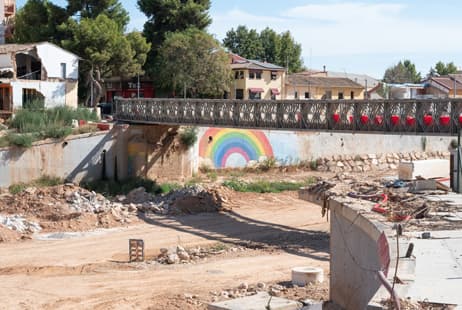
In normal circumstances CCS covers losses from extraordinary risks using the resources it has at its disposal. With over 70 years behind it, CCS has dealt with major crises. But what happened in Valencia was an entirely different occurrence. The intensity, the swiftness, and above all the volume of the losses outpaced all projections.
The main thing in these cases is to be able to cope with the massive volume of losses without delay. The flooding resulted in 250,000 claims. Taking the average annual number of claims over the previous 10 years, that volume of claims equalled four years of work by CCS, and this is where the insurance industry stepped forward.
To meet that challenge, Spain’s Ministry of Economy, Trade, and Business entered into an historic agreement with UNESPA on 13 November 2024. It arranged for a Special Operating Procedure (POE, for its initials in Spanish) in which 38 insurance entities, which together accounted for 98% of the insurance market in Valencia, would assist CCS in processing the claims to help expedite payment of compensation. CCS would still be responsible for paying the claims, but processing a portion of the claims from the losses that had occurred in Valencia was farmed out to insurers. At the same time, CCS directly took charge of handling the claims from other areas like Almería, Cuenca, and Castellón.
The result was an unprecedented level of mobilisation. A force of over 8,000 staff set to work in the field and remotely, coordinating efforts and keeping the support network up and running non-stop. They included claims processors, who carefully completed and continuously oversaw the file for each claim; claims adjusters, who prepared precise assessments of the losses; telephone help line operators, who took note of requests from insured parties and answered the most pressing questions; and more than 1,000 insurance mediators, who provided ongoing, personalised liaison between the system and the insured.
A procedural and technical challenge
The protocol set up a legal framework for cooperation between the insurers and CCS. Even so, this structure required developing an IT framework and procedures for implementing coordination between approximately forty insurers and CCS.
A computerised platform capable of handling tens of thousands of claims had to be developed in just a fortnight, with no time for start-up testing. The IT tool was built on an already existing software application for handling wind storm losses and rushed into operation. The system was tested in real time and tweaked on the basis of actual practice, cooperation between the parties, and unswerving commitment. Meetings went on around the clock, day in and day out. Many stretched on into the small hours of the night and over the weekends. This was what was called for in the circumstances. The citizens of Valencia and other parts of southeast Spain who were affected by the floods were in need.
The challenge was not just to create technology corridors for information transfer between the insurers and CCS. Loss assessment criteria and procedures had to be adapted, because the insurers were acting on behalf of CCS.
The Valencia Floods in figures
The size of the disaster is shown both by the number of claims and the estimated economic impact. The 250,000 claims involving both personal injuries and property damage ensuing from the Valencia Flood bear clear witness to the magnitude of the problem that was confronting the inhabitants of the Huerta Sur district in Valencia. Based on CCS data, the estimated cost has reached 4,800 million euros, a staggering amount that attests to the enormous size of the event and the pressure it put on the system of compensations.
The scale of the damage to all the sectors that were impacted can be readily seen from the following breakdown:
- 82,000 claims from homeowners and housing complexes.
- 144,000 automobile-related claims.
- 21,000 claims by businesses, offices, and industrial plant.
- 74 claims for damage to public infrastructure.
Nearly 50% of the claims submitted were processed for CCS by insurance entities. In all, they handled 116,000 claims totalling payouts of 1,250 million euros in compensation. The insurers mainly took charge of processing claims arising from the consumer insurance line. More specifically, private insurers took charge of 58% of the automobile insurance claims, 39.5% of home insurance claims, and 18.5% of claims from businesses.
That let CCS concentrate on processing more complicated claims like structural damage to residential buildings or business interruption in the industrial sector. This joint action made it possible to cut response times and offer the insured faster settlements and is a clear example of effective cooperation. This approach made a difference and showcases the ongoing development and improvement of Spain’s insurance system.
Claims paid by private insurers
The lion’s share of the Valencia Floods fell on the shoulders of CCS, but private insurers also had to bear the cost of significant claims arising from that event. Outside the framework of the POE, they handled 138,454 claims for losses caused by hail, rainfall, and winds under 120 km/h in all the provinces affected by the cut-off low. These events led to payouts of over 180 million euros more.
In the meantime, Agroseguro took charge of agricultural damage. Persimmon and citrus fruit production, extremely important crops in the region from both an economic and a social standpoint, were particularly hard hit. Though to a lesser extent, vegetable crops and grape vines also suffered considerable damage in certain areas. Overall, the event affected nearly 26,000 hectares of crop land spanning roughly 50,000 properties owned by large-scale growers and small family farmsteads. Agroseguro paid out total compensation on the order of some 60 million euros.
Lessons learned
So, what have we learned after the Valencia Floods? The flooding was a full-fledged stress test for Spain’s public-private partnership-based insurance system. There were problems, and many decisions had to be taken in a hurry, but the system worked. We responded rapidly, we implemented tools in record time, and we built bridges between institutions. All this was possible thanks to the solid foundation that was already in place. And also because we were capable of working together, talking things through, and acting calmly, quickly, and with immense dedication.
Now that we have seen what we can do under pressure, we ask ourselves: Why not devise a system in which the cooperation described above activates automatically, without need of improvisation?
The big takeaway to be drawn from this experience is clear: we need pre-defined, automatic, shared protocols for taking action, that are activated and set common gears in motion without contemplation and without delay in certain situations or when certain thresholds are reached.
For instance, a specialised technical commission that presses a button when a catastrophe occurs, and that simple action immediately sets in motion a cooperation network of insurers, government authorities, technical services, and digital platforms with clear criteria for distributing claims leaving no room for mistakes or duplication and with means for keeping the insured parties informed. This last point is critical, because when immediate payment of indemnities is not feasible, it is important to have a transparent system in place to keep the insured up to date about the status of their claims in real time. By the same token, the more complicated the processing, the more flexible the procedure for granting advance payments needs to be.
What we learned a year ago is that we can do this. What we have to do now is get better at it. Our aim is to take what was an emergency response and make it over into an anticipatory model with clear, pre-defined rules that are activated instantly. We want to adapt our system of safeguards to the conditions of a new day.
Closing the protection gap
The other major takeaway we need to draw from the Valencia Floods is that, despite the high insurance coverage rate in the Province of Valencia (75% of homes and 100% of vehicles), not everyone was protected.
The collective efforts and solid response system notwithstanding, many of the people affected by the floods did not have insurance that would help them start over. So, there are families that, after losing everything, were forced to rely solely on assistance provided by the central or regional governments.
When insurance is taken out, it helps get things back to normal. This was also shown by the El Campanar fire that took place barely six months ahead of the Valencia Floods. An entire block of flats went up in flames, but rebuilding has been started, made possible thanks to the complex’s insurance policy and the policies taken out by the respective owners of the units.
Our challenge is to ensure that all homes, businesses, and industrial plant in Spain are insured. This is not just a matter of protecting material property: it is a matter of protecting people’s plans for their futures.
The lack of insurance is not the only challenge that needs to be met. Coverage also needs to be adequate. That is, underinsurance must be avoided. Either because a person does not have broad enough coverage (consider, for instance, the importance of business interruption covers for businesses in circumstances like those caused by the Valencia Floods) or because the sums insured are insufficient. Just having insurance is not enough; the coverage of that insurance must be enough, too.
This means that we have to foster a culture of responsible insurance coverage and enhanced risk awareness. The sums insured need to be commensurate with the value of the property insured, and policyholders must also conscientiously engage in prevention.
Conclusions
Extreme weather phenomena are more and more frequent, intense and are affecting larger and larger areas. We live in an age when weather perils have become a harsh reality. That is our life today: precarious and vulnerable.
This is where insurance comes into play as a mechanism that brings stability to society as a whole and ensures that the progress that has been made will not be lost, one that becomes particularly prominent in extreme situations.
Prevention, awareness, and public-private partnership are essential to anticipate risks, minimise the impact of natural phenomena, and speed up recovery. If we have learned anything from the Valencia Floods, it is that in unsettled times, insurance is the only thing that can promise continuity.
In normal circumstances CCS covers losses from extraordinary risks using the resources it has at its disposal. With over 70 years behind it, CCS has dealt with major crises. But what happened in Valencia was an entirely different occurrence. The intensity, the swiftness, and above all the volume of the losses outpaced all projections.