The Floods Caused by the Cut-off Low in October–November 2024: The Greatest Challenge in the History of Extraordinary Risk Insurance
Director General
Consorcio de Compensación de Seguros
On the morning of 29 October 2024, as on every last Tuesday of the month, the Board of Directors of Consorcio de Compensación de Seguros (CCS) held its meeting. On this occasion, the Assistant Director of Research and International Relations gave a technical presentation on atmospheric convection and its manifestations: intense storms and other elements that facilitate them, such as cut-off lows (DANA in Spanish for the initials of depresión aislada en niveles altos). It was noted that at that time there was an active cut-off low over the eastern part of the Iberian Peninsula, which had already caused significant damage the previous day, mainly due to hail, affecting vehicles and greenhouse crops in the Province of Almeria. The inclusion of this topic on the Board’s agenda had been planned weeks earlier, as there had been an observed increase in the frequency of precipitation events capable of causing floods with severe damage.
Without going too far back in time, the flood that had resulted in the highest number of compensation claims until that day was caused by the cut-off low of September 2019, which severely affected the Vega Baja del Segura and the Mar Menor basin, between the Murcia and Alicante provinces. Also in 2023, there were very intense convective rainfall events, causing significant damage to the south of the city of Zaragoza in July and to Toledo and the southwest of Madrid in September.
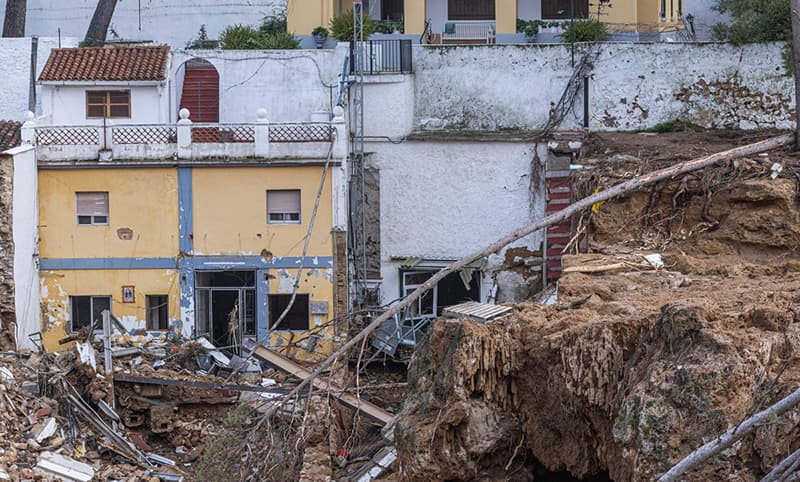
On the night of 29 October, we watched in dismay – like all citizens of this country and the rest of the world – the drama unfolding across a large metropolitan area of Spain and other nearby regions. We quickly realised that the magnitude of the catastrophe was going to be devastating, as it sadly was in terms of loss of human life and material damage, and the challenge its management would entail.
On the morning of 30 October, CCS issued its first briefing note, expressing solidarity with all those affected, and indicating that the entity would cover flood damage to insured property and persons, reminding them of the compensation criteria and the channels for submitting claims, and emphasising that there was no deadline for filing claims.
From that night onwards, this public entity has worked tirelessly to facilitate damage repair and enable affected individuals and businesses to recover as quickly as possible. This is the purpose of Extraordinary Risk Insurance: to make recovery possible even in dramatic, difficult and complex situations such as the one we were facing. We soon realised that this loss event would be unlike any other, even for an organisation that has had to deal with situations such as the Lorca earthquake in 2011, the 2019 cut-off low floods or the volcanic eruption in La Palma in 2021.
It was of utmost importance to adopt urgent measures to streamline the management of a loss event of the scale we were witnessing. To this end, we set up a special Committee, whose members were in contact almost all the time, without rest, to design the steps to be taken. Resources for assisting affected policyholders were strengthened. The Direction of Systems and Information Technologies increased the website’s capacity to handle compensation claims, which during the management of the loss event multiplied six fold, expressly recommending that claims be submitted online, and also using brokerage channels and insurance companies to send claims electronically to CCS as quickly as possible, thereby speeding up processing. The CCS Call Centre was also reinforced, with the number of operators increasing tenfold. CCS Regional Branch in the Region of Valencia played a key role in providing personalised assistance to those affected, attending to them daily from the outset. We will return to this point later.
Much of the measures for managing the loss event – organisation of appraisals, appraisal and compensation criteria – are detailed in other articles in the magazine written by the Direction of Operations, which, together with its sub-directorates for Claim Handling, Appraisals and Organisation and Quality, as well as all regional branches, bore the brunt of the operational management of the loss event on behalf of CCS. Undoubtedly, the effort made by brokers and loss adjusters has been exceptional, and we acknowledge and appreciate it.
More than 250,000 flood damage claims have been received and processed, over two-thirds of which were received during the first two weeks following the occurrence of the devastating event.
Since the early hours of 30 October, CCS was not alone in its endeavour to provide a swift response to this dramatic situation. The Directorate-General for Insurance and Pension Funds, whose head is also the CCS President, has led the management. The insurance sector as a whole, along with Unespa, brokers and loss adjusters made themselves available to Consorcio to support, facilitate and streamline the management of a loss event that was expected to be enormous and complex. The support of the Ministry of Economy, Trade and Business has been unwavering throughout this year.
Another initial measure, given the extent of the damage, was to try to define and estimate both the number of claims we would receive and their cost. These tasks involved the Sub-directorates for the Technical Area and Reinsurance, Research and International Relations and the Risk Management Direction. It soon became clear that this loss event would be a management challenge rather than a financial one, since, fortunately, the entity had sufficient resources to meet compensation payments. I must say that this is not the result of chance, but of sound planning within the Extraordinary Risk Insurance, which has generated ample funds, and of the Financial Direction’s prudent management of these resources over the years, enabling it to cope with loss events, even those as enormous and unprecedented in scale and cost as the one we are currently facing.
We also quickly realised that we would need to add more personnel to tackle this task. CCS increased its own appraisal force and claims handling staff thanks to the hiring of temporary personnel and the support of other CCS units, to whom we express our gratitude for their professionalism and collaboration throughout this year since that fateful day of 29 October 2024.
We were aware that in extraordinary situations, extraordinary measures must be taken. Another extremely important measure, as explained in other articles in this issue of the magazine, was to join forces with private insurance companies through the signing of a Special Operating Procedure (POE, for its initials in Spanish), whereby insurance companies were able to assess and process part of their claims for vehicles, homes, residential complexes, shops, premises, offices and industries, so that once the claims assigned to them were processed, they were sent to CCS for payment to the affected parties. Thirty-eight insurance companies joined the procedure, contributing manpower for the assessment and handling of 116,000 claims, which was crucial in speeding up the compensation process, and we thank them for their exceptional work. To reach the total of 250,000 opened claims, 134,000 claims have been handled by CCS’s internal resources, which, as of 29 October 2024, comprised 292 people.
Efforts have also been made by other areas within Consorcio. The Sub-directorate for Human Resources, part of the General Secretariat, undertook the task of redistributing part of the workforce that had some availability to support claim handling work, such as volunteer personnel from the Direction of Winding-up and Recovery of Insurance Companies. The General Services Department was also reinforced, as it had to handle calls, emails and face-to-face customer service far beyond its usual activity. In addition, recruitment processes were expedited to add more personnel to the DANA handling, particularly through the hiring of 113 temporary employees, at different times, who joined departments such as the Direction of Operations, both at headquarters and in regional branches – since all of them were involved in managing DANA claims – , the Policyholder Service or the Internal Audit Service.
In-person customer service was also strengthened at the CCS Regional Branch in the Region of Valencia. Although all procedures for claiming compensation can be carried out online, for months CCS office in Valencia has assisting dozens of people every day who came in person to submit their claims and seek personalised support to obtain some information amidst so much devastation. We extend our deepest gratitude to the 14 staff members – 10 permanent and 4 temporary – at the Valencia office for their dedication, hard work and professionalism, providing support to so many people who came and continue to come to the office seeking help to overcome this terrible situation as quickly as possible. During this time, they have received 21,000 visits.
Communication has also been a crucial aspect. In addition to that first briefing note of 30 October 2024, we have issued another 24 briefing notes, as well as 5 management notes outlining key criteria related to this loss event. All notes, published both in Spanish and English, have been made available to facilitate understanding for affected foreigners and to address requests for information on the scope and management of this globally significant catastrophe by our entity. Numerous requests for information from national and international media outlets – press, radio and television – have been handled. Social media engagement has been continuous. A document with frequently asked questions and answers was posted on CCS website and also disseminated via social media, with the aim of proactively clarifying doubts and facilitating access to information.
The Policyholder Service has seen its usual workload multiplied in this loss event, which, in terms of the number of claims alone, is equivalent to ten years of CCS work. Not to mention that, in 2024 and 2025, other loss events continued to occur, fortunately much smaller, which also had to be dealt with.
Sometimes, in the descriptive effort to explain what has been done, I may risk omitting units and departments. It is not my intention to omit anyone. The truth is that all CCS staff, from its 13 regional offices and its headquarters, has been fully committed to managing this loss event, beyond their ordinary duties, with a drive that has been sustained over time. I would like to take this opportunity to reiterate my gratitude to each and every member of CCS for their exemplary behaviour and commitment, which has helped to speed up the payment of compensation to policyholders.
We have seen that, when a catastrophe devastates entire neighbourhoods, it is essential to maintain the composure needed to organise the work and ensure that relief and recovery – in our case through compensation for insured property and people – reach all those in need as quickly as possible, which are many and simultaneous. From the deterioration of the most basic and everyday living conditions to the severe impact on the productive sector, when needs are so great, every action we took to remedy the situation became a necessary accelerator in claims handling; and so we did, approving measures to speed up the payment process in the Board of Directors.
Insurance is a reliable means, as it establishes a contract between the policyholder and the insurance company – in our case CCS – for compensation for damage. There is no other means like insurance that guarantees economic compensation for damage more quickly, favouring recovery. However, there are steps to ensure fairness in compensating for this damage that must be followed, involving verification of the insurance policy and its conditions and the assessment of damage. When there are so many needs to cover, so many tens of thousands of claims, and so many difficulties in the work, we must be aware that there are minimum timeframes in claim management that cannot be shortened. Such is the case with certain procedures, such as accessing affected properties or locating certain assets like vehicles swept away by the flood, which, despite all the measures adopted and the personal involvement of thousands of professionals, are tasks that require time to complete.
CCS – together with the insurance sector as a whole – has managed this loss event in a way that, when compared with similar catastrophes in other developed countries around us, has been extremely swift and efficient. We reached 50% of claims handled by mid-January 2025, 75% in the first week of March 2025 and 90% by mid-April 2025. On the first anniversary of the catastrophe, we had processed 98% of the claims received, and as of 10 December 2025 we have processed 98.4% of compensation claims. Even after a year, we continue to receive new compensation claims every day.
In economic terms, CCS has paid out nearly €4.1 billion at the time of this writing. These figures demonstrate the commitment of Spanish insurance, and of CCS in particular, highlighting the validity of the system that provides universal coverage at an affordable price (for residential properties, the cost of coverage is €7 per year for every €100,000 of insured capital) and that is capable of responding to extraordinary hydro meteorological and geological events of global scope, such as the floods caused by the cut-off low in late October and early November 2024.
This scheme, which was already attracting global attention in a context of increasing damage resulting from both climate change and growing exposure in all countries, has seen renewed interest from all over the world with the management of this severe loss event.
Things will never be the same after 29 October 2024. They will not be for the victims and their families, or for all those who have gone through this harsh and traumatic experience. Nor will they be for all of us who, in one way or another, have been involved in dealing with its consequences.
CCS has fully entered the management of billion-euro events. Many of the solutions adopted for managing this flood will, I am convinced, translate into new management criteria, as happened with the management of wind damage after Storm Klaus in 2009 or with appraisal criteria when there are so many total losses as in the geological risks of Lorca or La Palma. Many of the criteria and procedures adopted will be incorporated into CCS and the entire network of actors involved in Extraordinary Risk Insurance.
I would like to mention two milestones that have taken place at CCS in the year since October 2024: the 70th anniversary of the entity’s founding; and the end of 2025, a year in which a new Three-Year Action Plan for the period 2026–2028 must be prepared. The management of high-impact loss events, which was already included in the previous Three-Year Action Plan 2023–2025, is seeing its relevance and attention increase, and we propose that it be developed much more extensively, taking advantage of the lessons learned from this challenging year we have had to face professionally.
With the memory of the 238 people who lost their lives (230 in the Region of Valencia only), their families and all those affected, I hope I have explained how we have sought to fulfil our mission of providing economic resilience after such a tragic catastrophe. If anything has become clear, it is that having insurance is absolutely essential.

The floods of 29 October 2024, which particularly affected the province of Valencia, resulted in the largest loss event in the 71-year history of Consorcio de Compensación de Seguros. This article details all the measures the organization has had to adopt throughout this year to manage this loss event and provide an effective insurance response.